
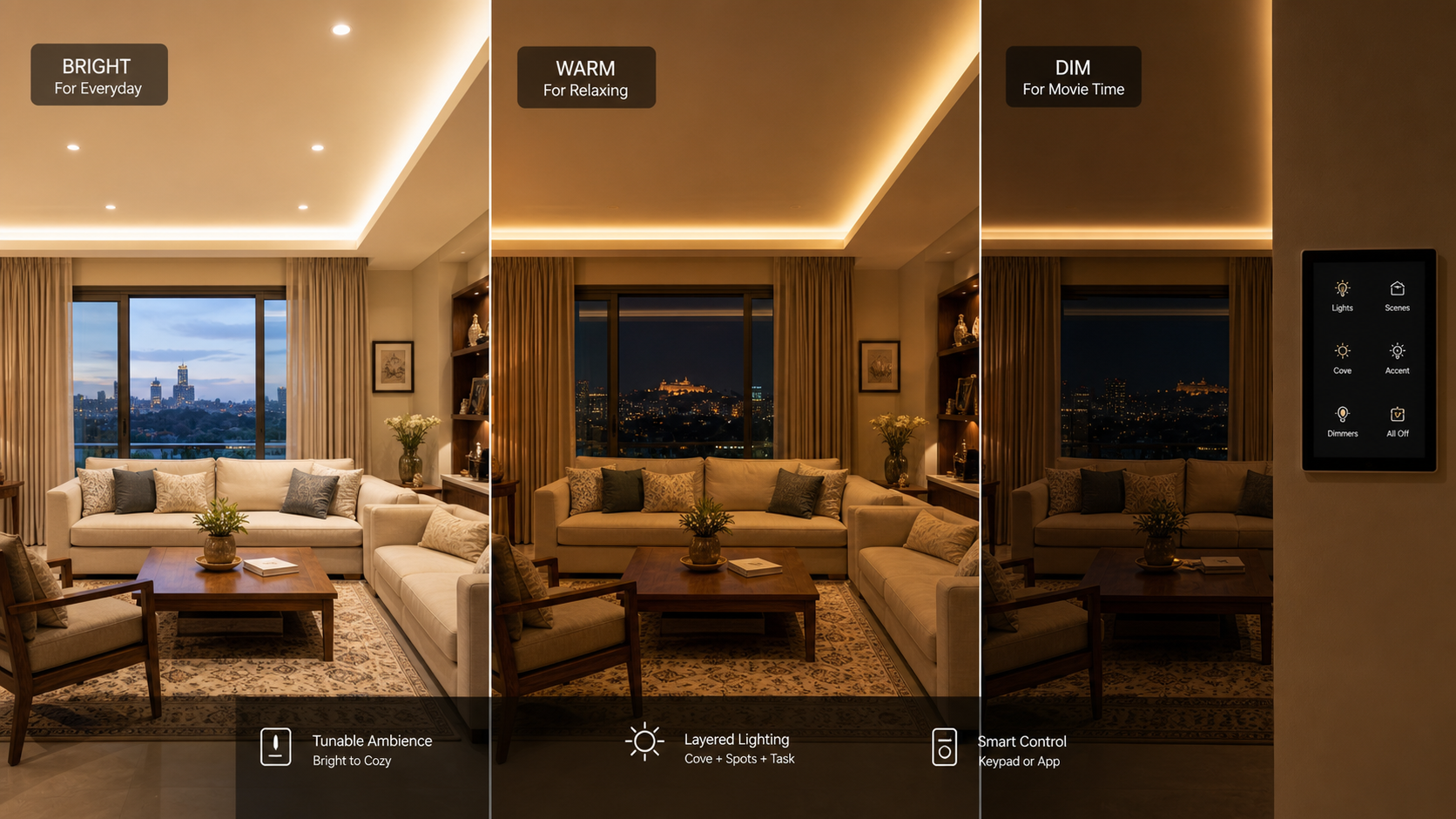
When people explore home automation, lighting is often the feature that creates the biggest visible difference first. Good smart lighting does more than improve convenience. It changes the emotional quality of the room. It makes bedrooms calmer, living rooms more layered, and dining areas more intentional.
If you want the broader system view first, start with the main home automation guide.
Why lighting now matters more in home interiors
Modern interiors are no longer designed around one bright central light. Homeowners want spaces that feel softer, warmer, and more adaptable across different times of day. That makes lighting part of the interior experience rather than only a utility layer.
- Morning spaces need clarity and freshness
- Evening spaces need warmth and calm
- Living rooms need different moods for conversation, relaxation, and entertainment
- Bedrooms need gentler transitions between wake-up and rest
Smart lighting changes ambience through scenes
The biggest shift comes from scenes. Instead of using the same brightness and color tone all day, smart lighting lets the room respond to the moment.
- Morning scenes can feel clean and energizing
- Evening scenes can feel warmer and softer
- Dining scenes can feel more intimate and composed
- Night scenes can reduce glare and visual stress
This is one reason scene-led lighting has become central to modern smart homes. Read Why Scene-Based Automation Is Better Than App-Only Smart Devices.
Why tunable lighting matters
Tunable lighting allows the color temperature of the light to shift through the day. That means the same space can feel more awake, more neutral, or more relaxed depending on when and how it is being used.
Without tunability, the room is stuck in one lighting character. That is often why even expensive interiors can feel visually flat at the wrong time of day.
Tunable smart lighting is worth considering because it helps:
- match light tone to natural daily rhythms
- make morning and evening scenes feel genuinely different
- improve how materials, textures, and colors read in the room
- reduce the harshness of one fixed light temperature across all situations
Why dimmable lighting matters just as much
Dimming is often more valuable than adding extra fixtures. It changes how the room feels without changing the architecture.
- A living room at full brightness can feel practical but flat
- The same room dimmed correctly can feel calm and premium
- A bedroom with dimming feels more suitable for winding down
- A dining space becomes more intentional when brightness is controlled properly
Dimmable lighting gives the room range. That range is what creates ambience.
Smart lighting makes interiors feel more premium
Many homes feel premium not because they have more products, but because the mood changes are more controlled. Smart lighting supports that by making interiors feel deliberate instead of fixed.
That is why smart lighting has become one of the strongest links between interior design and home automation. It helps the home feel designed in use, not just in photographs.
Read What Makes a Smart Home Feel Premium, Not Complicated?.
Which rooms benefit most from tunable and dimmable smart lighting?
The strongest impact is usually in:
- living rooms
- bedrooms
- dining areas
- family lounges
These are the spaces where atmosphere matters most. Read Best Home Automation Ideas for Bedrooms, Living Rooms, and Dining Areas.
Smart lighting also improves control, not just mood
Good ambience is only part of the value. Smart lighting also reduces control friction through scene-based operation. Instead of adjusting multiple circuits manually, the homeowner can trigger one scene from a keypad and get the right result immediately.
That is especially useful in homes where people want the lighting to change often but do not want to keep making the same manual adjustments every day.
Why everyone should at least consider tunable and dimmable smart lighting
Not every home needs an extremely elaborate smart-lighting plan. But almost every well-designed home should at least consider tunable and dimmable lighting in key spaces because it improves:
- daily comfort
- visual ambience
- scene quality
- flexibility across different uses of the same room
- the sense of refinement in the interior
It is one of the few upgrades that changes the home both functionally and emotionally.
Planning matters more than the feature list
Tunable and dimmable lighting only works well when the overall lighting plan is strong. The room still needs the right layers, the right zoning, and the right control points.
Read How to Plan Smart Lighting for a New Home and our practical lighting-type guide.
Final thoughts
Smart lighting is changing home interiors because it gives rooms more emotional range. Tunable and dimmable smart lighting helps the same space feel brighter, softer, calmer, warmer, or more focused depending on the time and purpose. That is why it is no longer just a smart-home feature. It is becoming a core interior-design decision.
If you want to explore the product side, see smart lighting. For a broader smart-home planning view, go back to the main home automation guide.